





What Is a Load Cell and How Does It Work?
A load cell is a transducer that converts an applied mechanical force into a measurable electrical signal. It is widely used in weighing scales, industrial machinery, automated production equipment, tank weighing systems, and structural force monitoring.
Most industrial load cells operate using strain gauge technology. When a force is applied to the sensing element, the material undergoes a small elastic deformation. Strain gauges attached to the element change their electrical resistance in response to this deformation.
Basic Measurement Principle: Applied Force → Elastic Deformation → Strain Gauge Resistance Change → Electrical Signal → Signal Processing → Weight or Force Measurement
Main Components of a Load Cell
Elastic element: A specially designed metal structure that deforms predictably under load.
Strain gauges: Electrical sensing elements that detect changes in mechanical strain.
Wheatstone bridge: A circuit commonly used to convert small resistance changes into a measurable voltage signal.
Signal interface: Electronics or external instrumentation that converts sensor output into meaningful force or weight values.
Depending on the configuration, a load cell may measure compression, tension, shear force, or combinations of these loading conditions. Common mechanical designs include S-type, beam, single-point, pancake, and compression load cells.
It is important to distinguish the mechanical design of a load cell from its signal output type. For example, an S-type load cell may be available with either analog or digital signal processing, depending on the manufacturer and model.
Analog vs. Digital Load Cell: Key Differences
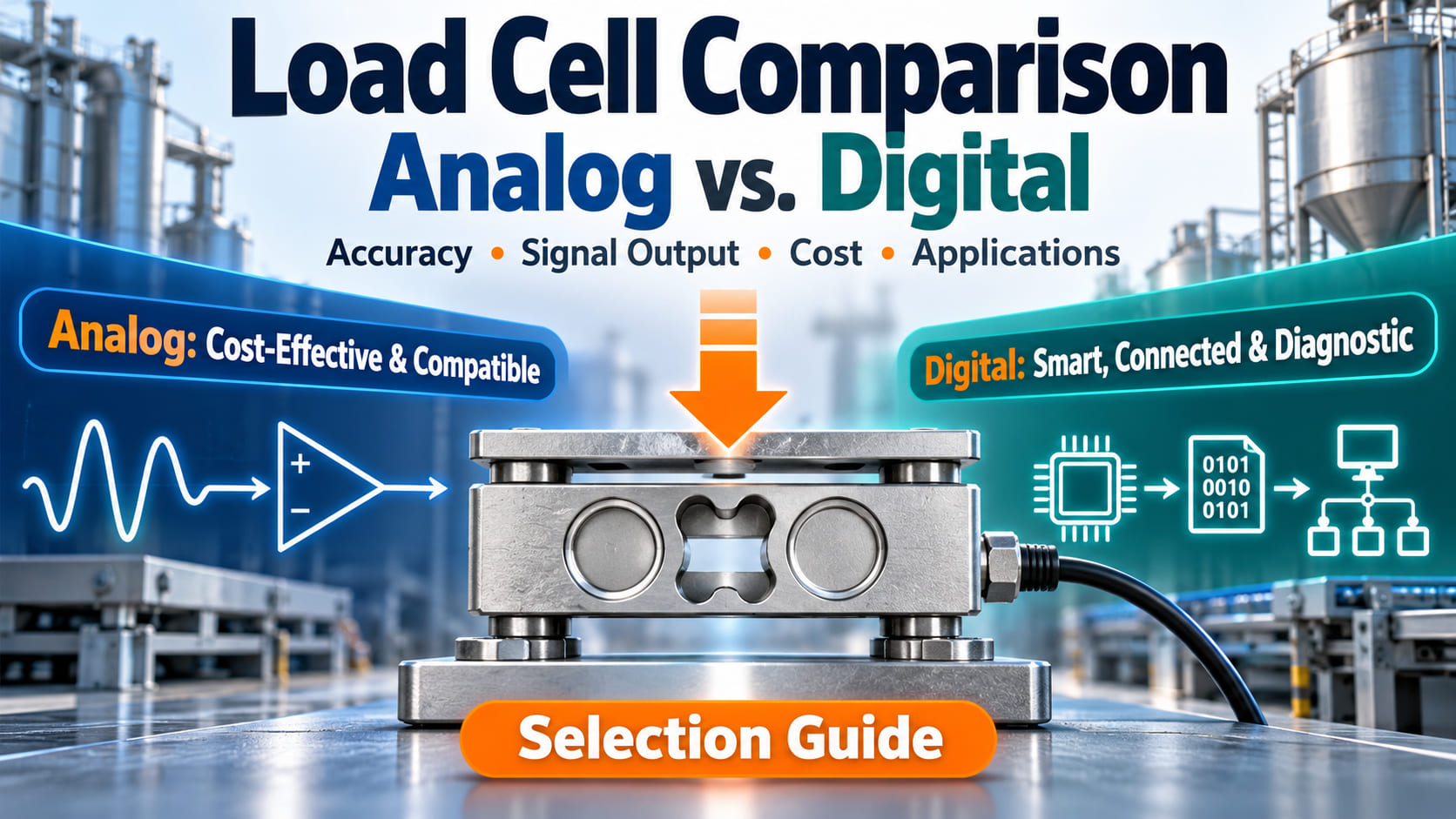
The fundamental difference between analog and digital load cell systems is where the electrical signal is processed and converted into digital measurement data.
An analog load cell typically produces a low-level voltage signal measured in millivolts per volt (mV/V). This signal must be amplified and processed by an external indicator, transmitter, or controller. A digital load cell incorporates electronic processing and analog-to-digital conversion within the sensing assembly, allowing measurement data to be transmitted digitally.
| Comparison Item | Analog Load Cell | Digital Load Cell | Best Suited For |
|---|---|---|---|
| Signal Output | Low-level analog voltage, commonly mV/V | Digitally encoded measurement data | Depends on the controller interface |
| Signal Processing | External amplifier or indicator | Integrated conversion and processing | Digital for integrated measurement systems |
| Initial Sensor Cost | Often lower | Often higher due to embedded electronics | Analog for limited sensor budgets |
| Noise Susceptibility | Low-level signals require careful shielding | Digital transmission can improve noise resilience | Digital for electrically demanding installations |
| Measurement Accuracy | Can achieve high accuracy with quality instrumentation | Can achieve high accuracy with integrated compensation | Evaluate full system specifications |
| Communication | Requires a compatible analog input interface | May support RS-485 or other specified protocols | Digital for supported networked systems |
| Diagnostics | Primarily external troubleshooting | Some models provide individual sensor diagnostics | Digital for supported remote diagnostics |
| Installation | Requires signal conditioning and careful wiring | Requires protocol configuration and compatible hardware | Depends on existing equipment |
| Maintenance | Straightforward electrical testing | May offer diagnostic tools but has more electronics | Depends on technical support resources |
| Typical Applications | Bench scales, platform scales, conventional machinery | Smart weighing networks, automated systems, large installations | Based on integration requirements |
Key takeaway: Digital load cells do not automatically provide better mechanical measurement accuracy than analog load cells. The overall performance depends on sensor specifications, excitation stability, signal conditioning, environmental conditions, installation quality, and calibration.
Analog Load Cell: Advantages and Limitations
An analog load cell is widely used in traditional industrial weighing systems because of its established technology, broad equipment compatibility, and relatively straightforward sensor construction.
Advantages of Analog Load Cells
1. Lower initial component cost: Conventional analog designs can be economical for standard weighing installations.
2. Broad availability: Many capacities, configurations, and mechanical mounting styles are readily available.
3. Compatibility with existing indicators: Analog load cells are useful when upgrading a sensor while retaining compatible signal conditioning hardware.
4. Flexible instrumentation selection: Engineers can select an external amplifier, transmitter, or high-resolution measurement system according to project requirements.
Limitations of Analog Load Cells
The primary limitation of an analog load cell is the sensitivity of its low-level electrical signal. Poor shielding, unstable excitation voltage, inadequate grounding, and unsuitable cable routing can introduce measurement errors.
Analog systems may also require additional hardware for signal amplification and digital communication. However, these limitations can often be managed through appropriate system engineering, making analog load cells a reliable choice for many industrial applications.
Digital Load Cell: Advantages and Limitations
A digital load cell combines mechanical force sensing with electronic signal conversion. Instead of transmitting only a low-level analog voltage to a distant measuring instrument, it provides digital measurement data through a compatible communication interface.
Advantages of Digital Load Cells
1. Integrated signal conversion: Embedded electronics reduce the need to transmit an unamplified sensor signal over long cable runs.
2. Improved communication capabilities: Compatible models can exchange measurement data with industrial controllers and monitoring systems.
3. Diagnostic functions: Some digital models support status monitoring, error detection, and individual sensor identification.
4. Digital compensation: Certain devices incorporate calibration coefficients and compensation functions within their electronics.
5. Multi-sensor integration: Supported digital architectures may simplify monitoring and troubleshooting across multiple weighing points.
Limitations of Digital Load Cells
Digital load cells generally involve additional electronic components, which may increase the initial purchase price. Compatibility can also become a concern because manufacturers may use different communication protocols, software tools, and configuration procedures.
Their internal electronics may also introduce environmental limitations relating to temperature, moisture, electrical transients, and long-term serviceability. A digital load cell should therefore be evaluated as a complete sensing and communication device, rather than selected solely because it provides digital output.
Three Application Scenarios: Which Load Cell Should You Choose?
Scenario 1: Beginners and Standard Weighing Applications
For basic weighing platforms, laboratory prototypes, small industrial scales, or equipment using existing analog instrumentation, an analog load cell is often a practical starting point.
These applications generally prioritize straightforward integration, sufficient measurement accuracy, and predictable equipment costs. A properly specified analog load cell paired with a compatible amplifier can deliver dependable performance without requiring complex digital communication configuration.
Recommended choice: Analog load cell with a suitable indicator or signal transmitter.
Scenario 2: Budget-Conscious Equipment Manufacturers
Equipment manufacturers often evaluate load cell pricing based on total production cost. For machines requiring only one or two sensing points, analog load cells may provide a favorable balance between component cost and measurement capability.
However, purchasing decisions should also consider the cost of signal amplifiers, wiring, calibration labor, and maintenance. When multiple sensors are involved, a digital architecture may offer operational benefits that justify a higher initial investment.
Recommended choice: Analog load cells for simpler, cost-sensitive systems; compare total installed costs for larger systems.
Scenario 3: Automated Production and Remote Monitoring
Automated production lines may require continuous measurement data, distributed sensors, diagnostic information, and integration with programmable logic controllers or supervisory control systems.
Digital load cells can be particularly useful when the selected model provides supported communication protocols and individual sensor monitoring. Applications may include automated batching systems, industrial process weighing, vehicle scales, and connected weighing equipment.
Recommended choice: Digital load cell with verified controller compatibility and suitable diagnostic features.
How to Select the Right Load Cell
Selecting a load cell involves more than comparing analog and digital output. The following technical factors should be reviewed before choosing a model.
1. Load Capacity and Overload Protection
Determine the maximum expected force, including the weight of fixtures, containers, and supporting equipment. Dynamic forces, shock loads, and uneven loading must also be considered. Select a rated capacity with an appropriate engineering margin while preserving sufficient measurement resolution.
2. Accuracy and Repeatability
Review the manufacturer's specifications for nonlinearity, hysteresis, repeatability, creep, and temperature effects. For commercial weighing applications, applicable metrological approval and accuracy classification may also be necessary.
3. Measurement Direction
Determine whether the sensor will measure compression, tension, or both. The mechanical structure must match the actual loading direction. Side forces and bending moments can affect measurement performance even when the load remains within the rated capacity.
4. Environmental Protection
Consider exposure to moisture, chemicals, dust, vibration, washdown procedures, and temperature changes. Stainless steel construction and an appropriate ingress protection rating may be preferable for demanding industrial environments.
5. Electrical Output and Communication
Confirm the input requirements of the weighing indicator, PLC, or data acquisition system. Analog models may specify mV/V sensitivity, bridge resistance, and excitation voltage. Digital models require confirmation of communication protocol, power requirements, update rate, and device compatibility.
6. Mounting Dimensions and Mechanical Integration
Review dimensional drawings, thread sizes, loading surfaces, mounting hardware, and recommended installation methods. Mechanical compatibility is essential because unsuitable mounting can introduce errors that cannot be corrected through electronic calibration alone.
Load Cell Price and Total System Cost
Load cell prices vary considerably based on capacity, accuracy, material, environmental protection, certification, customization, and signal processing features.
Analog load cells often have a lower purchase price because they contain fewer integrated electronic components. However, additional hardware may be required to amplify, convert, and transmit measurement signals.
Digital load cells may cost more individually, but some systems benefit from integrated conversion, communication functions, and diagnostic capabilities that reduce other integration requirements.
Factors Affecting Load Cell Pricing
1. Rated measurement capacity and mechanical construction
2. Accuracy grade and performance specifications
3. Aluminum alloy or stainless steel construction
4. Environmental sealing and ingress protection
5. Analog output or integrated digital electronics
6. Calibration documentation and certification
7. Order quantity, customization, and support requirements
When comparing quotations, consider the total cost of ownership, including installation, instrumentation, calibration, troubleshooting, replacement parts, and system downtime. The lowest-priced load cell is not necessarily the most economical solution over the equipment's operating life.
Six Common Load Cell Selection Mistakes
Mistake 1: Choosing capacity based only on nominal weight. Unexpected impact loads, off-center forces, and mechanical shock can overload the sensor.
Mistake 2: Assuming digital load cells are always more accurate. Accuracy depends on the entire measurement system, not simply the output format.
Mistake 3: Ignoring environmental conditions. Moisture, aggressive cleaning chemicals, and temperature extremes may shorten sensor service life.
Mistake 4: Overlooking interface compatibility. A load cell may have excellent specifications but still be unsuitable for the intended indicator or PLC.
Mistake 5: Installing the sensor incorrectly. Side loading, misalignment, poor mounting surfaces, and cable strain can introduce measurement errors.
Mistake 6: Focusing only on purchase price. Instrumentation, calibration, installation, and maintenance costs should be included in the purchasing decision.
Load Cell Installation and Calibration
Correct installation and calibration are necessary for reliable load cell performance. Even a high-quality sensor can produce inaccurate readings when subjected to mechanical distortion, unintended lateral force, or improper electrical connections.
Step 1: Confirm Mechanical Alignment
Install the load cell according to the manufacturer's recommended loading direction and mounting arrangement. Avoid excessive side forces, twisting moments, and unintended mechanical constraints.
Step 2: Verify Electrical Connections
Confirm cable wiring, power supply, excitation requirements, shielding, and grounding. For digital models, verify communication settings and device addressing where applicable.
Step 3: Perform Zero and Span Calibration
Establish the correct zero point and calibrate the measurement system using suitable reference loads or a validated calibration method. Follow the equipment manufacturer's instructions and applicable measurement requirements.
Step 4: Verify Repeatability and Measurement Stability
Apply and remove known loads to evaluate consistency. Where necessary, perform checks at multiple load points, including loading and unloading sequences, to assess system behavior.
Step 5: Establish a Maintenance Schedule
Inspection and recalibration intervals should reflect operating conditions, measurement criticality, manufacturer guidance, and applicable quality requirements. Regularly inspect mounting hardware, cables, seals, and signs of mechanical overload.
Final Recommendation: Analog or Digital Load Cell?
The best load cell is not necessarily the one with the most advanced electronics. It is the model that provides the required measurement performance, mechanical compatibility, environmental protection, and signal interface at an acceptable total system cost.
Choose an analog load cell when your application uses established weighing instrumentation, requires a straightforward sensor replacement, or prioritizes economical integration. Choose a digital load cell when integrated communication, sensor-level monitoring, or distributed measurement functions provide meaningful operational advantages.
Need Help Selecting a Load Cell?
Provide your required load capacity, accuracy, measurement direction, installation conditions, and output interface when requesting a quotation. These details help suppliers recommend suitable analog or digital load cell models and identify potential integration requirements.
Request a Technical Consultation or Load Cell Quotation
 -
-